
A Dialogue that refuels the re-assessment of Christian Political Leadership
About the Christian Political Leadership
Dr. Yousaf Riaz
5/27/20267 min read
Introduction
The expectations people have from their leaders vary from person to person and community to community. Followers often compare their leaders with the leadership models of other nations and, based on those comparisons, develop opinions that either appreciate or criticize their performance. Such comparisons create opportunities for reflection, growth, and improvement.
Effective leadership depends upon the ability to respond wisely rather than react emotionally. Visionary leaders are those who listen carefully to diverse perspectives and use constructive criticism as a source of learning and transformation. The capacity to understand the concerns, aspirations, and expectations of the people strengthens trust and national unity.
Followers desire leaders who are intellectually, morally, socially, and politically equipped to represent their collective voice on both national and international platforms. Strong leadership not only preserves the uniqueness and identity of its people but also promotes inclusivity, dialogue, and cooperation with others who may hold different viewpoints.
In today’s interconnected world, responsible leadership requires wisdom, emotional maturity, strategic thinking, and the ability to build bridges among diverse communities. Leaders who embrace inclusivity while maintaining their nation’s values and identity are more likely to inspire confidence, stability, and sustainable progress.
As discussions about the event continue across the internet and social media, it remains unclear whether the gathering was intended as a political discussion, a formal debate, or simply a corner meeting. However, one important aspect became evident: the significance of freedom of speech in democratic countries like the USA, where diverse opinions and open dialogue are considered essential pillars of society.
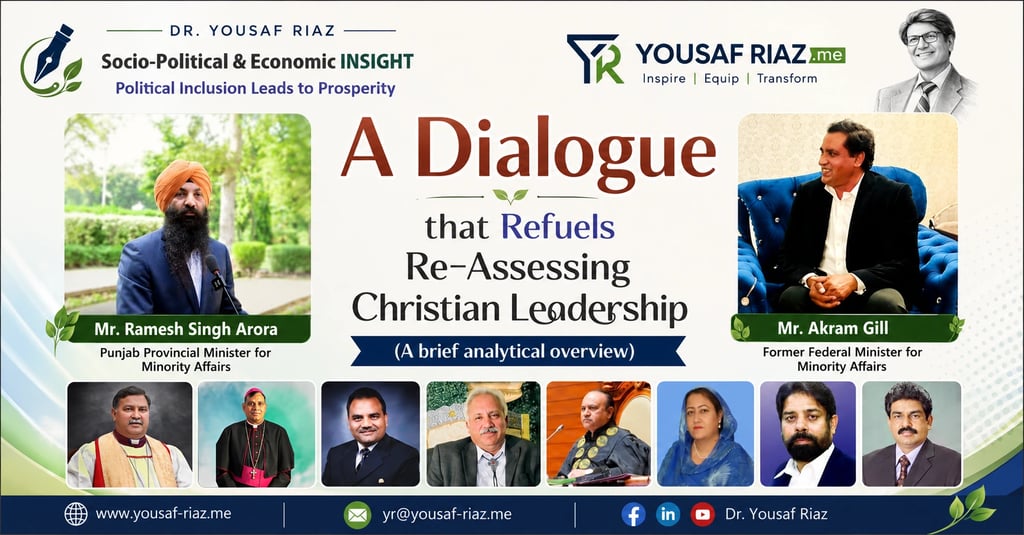
I respect both of them, as they represent minority communities in Pakistan: Mr. Akram Gill, former Federal Minster for Minorities Affair and Mr. Ramesh Singh Arora, Punjab Provincial Minister for Minorities Affairs.
In his opening remarks, Mr. Akram Gill highlighted many important issues and challenges faced by the Christian community — concerns that, unfortunately, remained unresolved not only during his tenure but also during the tenures of other Christian ministers. His discussion reflected longstanding social, political, and community-related concerns that still require serious attention and practical solutions.
However, it appeared that either the occasion was not fully appropriate for such a detailed discussion, or there may not have been sufficient preparation to present these sensitive matters in a more structured and comprehensive manner. At times, he seemed to struggle to fully integrate his thoughts, verbal expression, and body language while attempting to communicate the pain, concerns, and aspirations of the Christian community.
Mr. Ramesh Singh Arora reacted strongly his reaction composed with chronological and statistical regards He showed the gray areas of the Christian political leadership. His thoughts and -body language were composed except the reactionary expression. I appreciate his analysis to awake the Christian Leadership and the community.
Ramesh Singh Arora responded strongly and confidently, presenting his arguments in a chronological and statistical manner. During the discussion, he highlighted several gray areas within Christian political leadership and emphasized the need for more effective representation, strategic planning, and community engagement.
His thoughts, communication style, and body language generally appeared composed and well-structured, although at certain moments his expressions reflected a reactionary tone in response to criticism and sensitive remarks. Nevertheless, his analysis carried important observations that may encourage reflection within both Christian leadership and the Christian Community.
Instead of criticizing leadership afterward, the community should maintain close observation, remain actively engaged, and contribute through constructive and positive criticism. Healthy accountability, thoughtful feedback, and continuous dialogue can help leadership improve while also strengthening trust, unity, and collective progress within the community.
There are numerous analytical writings, social media discussions, and video opinions circulating online — some defending Christian political representation, while others are pointing toward the need for greater moderation and balance in Mr. Arora’s reactionary speech. These differing perspectives reflect the diversity of thought within the community and highlight the importance of constructive dialogue, responsible communication, and mature political engagement when addressing sensitive community-related issues.
After critically analyzing the aftermath of the event, I believe it created an important opportunity to positively review leadership performance, reassess the current socio-economic condition of the community, and reflect upon the lifestyles and priorities of leadership after serving in national offices on behalf of underprivileged and resource-constrained communities.
Such reflection is necessary to evaluate whether leadership has remained connected with the real struggles, aspirations, and development needs of the people they once represented. It also opens space for constructive accountability, community awareness, and a renewed commitment toward sincere, people-centered leadership focused on collective growth and empowerment.
In light of the situation, I developed a few important questions and also brainstormed possible answers to better understand the realities, challenges, and future direction of the community and its leadership. Such critical reflection can help encourage constructive dialogue, self-assessment, and a more responsible approach toward representation, and socio-economic development.
Truth Begins with Questions
1. Is Minority Communities’ Political Leadership Truly People-Centered?
All minority representatives are nominated by major political parties rather than directly elected by their communities. As a result, many leaders often have limited grassroots connections, weak community engagement, and less direct accountability to the marginalized communities they represent.
This situation has created a growing perception that symbolic representation alone is insufficient without consistent interaction, inclusive dialogue, and practical efforts focused on the socio-economic empowerment and development of the community.
1.1 Does the Political Bond with Marginalized Communities Remain Intact After Public Office Tenure Ends?
In many cases, the political bond between leaders and marginalized communities weakens after public office tenure ends. Generally, these relationships remain stronger with urban elites, influential circles, and politically connected groups, while connections with grassroots and underprivileged communities gradually diminish over time.
A truly people-centered leader maintains relationships beyond political power and public position. Sustainable leadership is measured not by temporary visibility during tenure, but by long-term commitment, accessibility, accountability, and continued service to marginalized communities.
2. Does Church Leadership Matter
Yes, church leadership matters significantly, especially in communities living as religious minorities. In such contexts, places of worship often become people-centered institutions, and faith leaders naturally influence not only spiritual matters but also social, political, and economic concerns of the community. Therefore, church leaders are expected to demonstrate exemplary leadership traits, moral integrity, humility, and service-oriented behavior.
In the Pakistani Christian context, church leadership remains highly community-centered. In recent years, many Pentecostal churches have shown stronger grassroots engagement and closer community connectivity. However, the Church of Pakistan has often struggled to demonstrate effective Christ-centered leadership transition and practical application in everyday community life.
In many cases, leadership positions become associated with social status, privileges, influence, and institutional control. As a result, some leaders appear reluctant to leave positions or develop second-line leadership through mentorship and succession. True Christ-based leadership, however, requires humility, accountability, sacrifice, and the willingness to empower others through servant leadership and role-modeling.
3. Can Borders Affect Leaders’ Connection and Engagement with Their Communities?
Yes, borders can significantly affect leaders’ connection and engagement with their communities. Generally, there are two types of political leaders who leave their homelands.
The first are leaders who genuinely mobilize and empower their communities. Because of their influence, public support, or political resistance, they sometimes become a challenge to existing power structures or governments and are forced to leave the country. Despite living abroad, their emotional connection, community engagement, and political relevance often remain intact. Through continuous struggle, sacrifice, and credibility, many eventually return with dignity and respect.
The second type includes leaders who, after enjoying privileged public offices and positions, gradually distance themselves from grassroots realities and settle in advanced countries for a more comfortable and secure lifestyle. In many cases, social media becomes their primary means of maintaining visibility and occasional engagement with their communities. However, over time, the physical distance, changing priorities, and reduced direct interaction weaken their practical connection with the marginalized people they once represented.
At this stage, it is also important to acknowledge some Christian political leaders in Pakistan who have sincerely served their communities through public representation, advocacy, and social engagement. Leaders such as Shahbaz Bhatti, J Salik, and Asia Nasir are often remembered for raising minority concerns at national and international levels.
Despite facing political, social, and institutional challenges, these leaders contributed toward highlighting issues related to minority rights, religious freedom, education, social justice, and community representation. Their efforts reflect the importance of courageous, community-connected, and service-oriented leadership within marginalized communities in Pakistan.
In the Pakistani context, communities generally remain more connected with leaders who continue to share their struggles, maintain regular engagement, and demonstrate long-term commitment beyond political office, status, or geographical borders.
4. Do Leaders’ Ego-Based Decisions Affect Poor Communities’ Growth and Development?
Yes, borders can significantly affect leaders’ connection and engagement with their communities. Generally, there are two types of political leaders who leave their homelands.
The first are leaders who genuinely mobilize and empower their communities. Because of their influence, public support, or political resistance, they sometimes become a challenge to existing power structures or governments and are forced to leave the country. Despite living abroad, their emotional connection, community engagement, and political relevance often remain intact. Through continuous struggle, sacrifice, and credibility, many eventually return with dignity and respect.
The second type includes leaders who, after enjoying privileged public offices and positions, gradually distance themselves from grassroots realities and settle in advanced countries for a more comfortable and secure lifestyle. In many cases, social media becomes their primary means of maintaining visibility and occasional engagement with their communities. However, over time, the physical distance, changing priorities, and reduced direct interaction weaken their practical connection with the marginalized people they once represented.
In the Pakistani context, communities generally remain more connected with leaders who continue to share their struggles, maintain regular engagement, and demonstrate long-term commitment beyond political office, status, or geographical borders.
5. Does the Christian Community Have Supper/Mature Leaders Who Can Calm Situations and Maintain Inclusivity for the Long-Term Benefit of Marginalized Communities?
The Christian community needs mature, wise, and people-centered leaders who can calm tensions, promote inclusivity, and guide communities with patience, humility, and accountability. In marginalized societies like the Pakistani Christian community, leadership should not be driven by emotions, personal interests, or divisions, but by long-term vision, unity, and community empowerment.
Strong leadership is demonstrated through dialogue, reconciliation, and the ability to keep communities connected despite differences in opinions, denominations, or political affiliations. Mature leaders help transform criticism into constructive engagement and ensure that short-term reactions do not damage the long-term socio-economic growth and collective dignity of marginalized communities.
Introduction

© 2025. All rights reserved.
+92-313-1510171
Messages only
contact@yousaf-riaz.me